Exhibition · 2025
What hands remember, the table holds
There are gestures that outlive the hands that made them. A way of folding dough, of weaving cloth, of shaping clay. Movements passed on through generations without ever being written down, carried quietly across time in the body’s memory. I think of these gestures as a kind of language. A language that speaks through repetition, care, and politics of touch. A language my grandmother spoke so beautifully, as grandmothers often do. Without words, they leave a legacy through the craft that is reduced into a domestic duty, but should be regarded as art.
Because the table cloths she carefully weaved with a loom from scratch truly are art. The weaving happened in between her other errands; cooking for the family, cleaning and scrubbing, mending clothes worn out in the farm work. Today, these table cloths hold such a sacred place in our family that we don’t even dare to use them; they’re stashed away in a closet by my mother. In her mind usage risks staining them, and it would be like staining her image. Yet for when she was taught weaving, it was a measure of her value as a woman, as a keeper of the house.
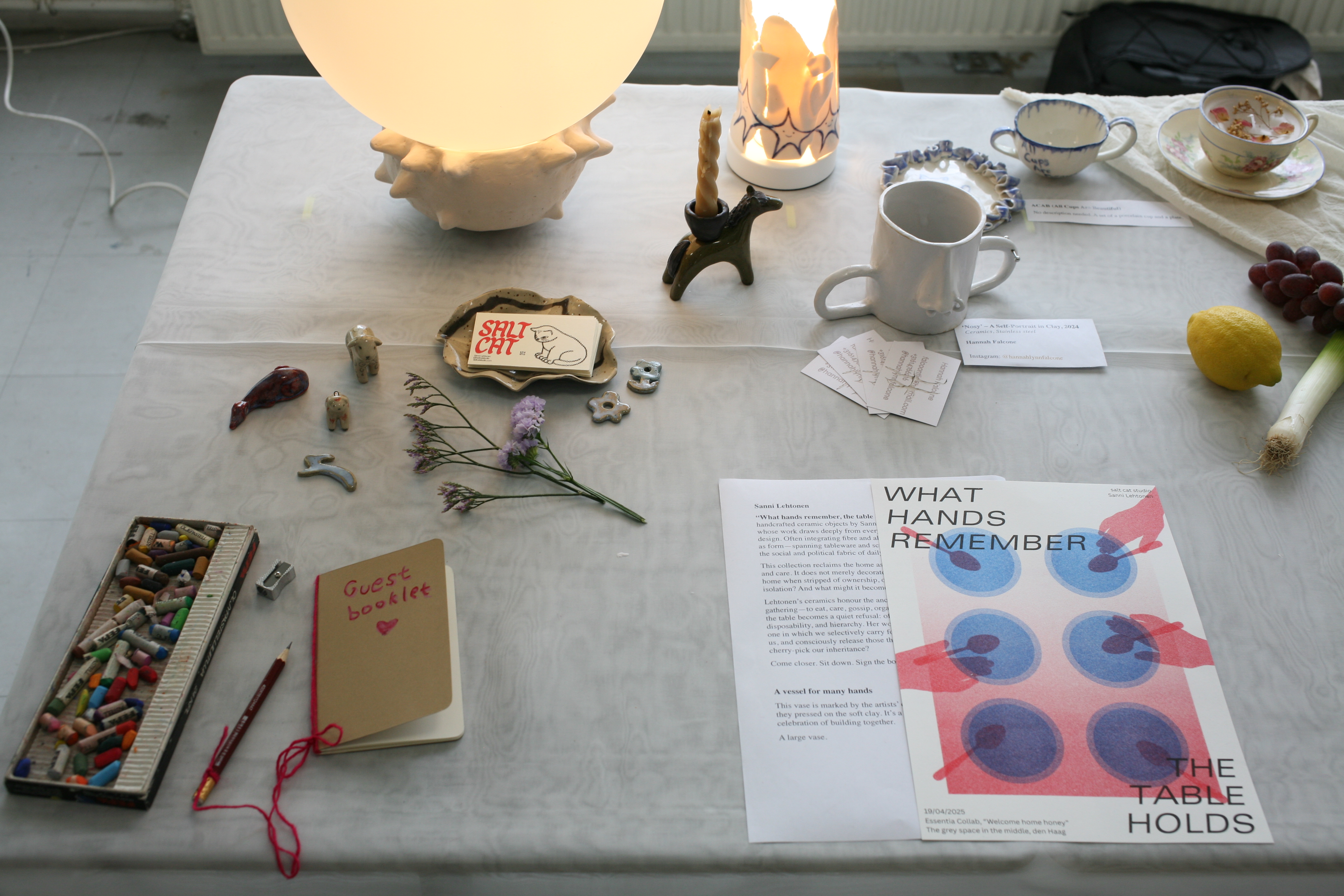
The table is an endless metaphor for power. Who sits where, who serves the food, who eats first; from family dinners to parliaments and boardrooms, the table maps our hierarchies. It can unite and it can exclude. Every invitation implies someone left outside the door. To gather around a table, then, is never neutral; it is always a political act.
Still, the same table that divides can also be reclaimed. When we share food, a cup of tea, or a story, we enact a counter-politics. We remind ourselves that solidarity can begin in the simplest of ways; by recognising each other’s presence, by listening, by passing something from one hand to another.
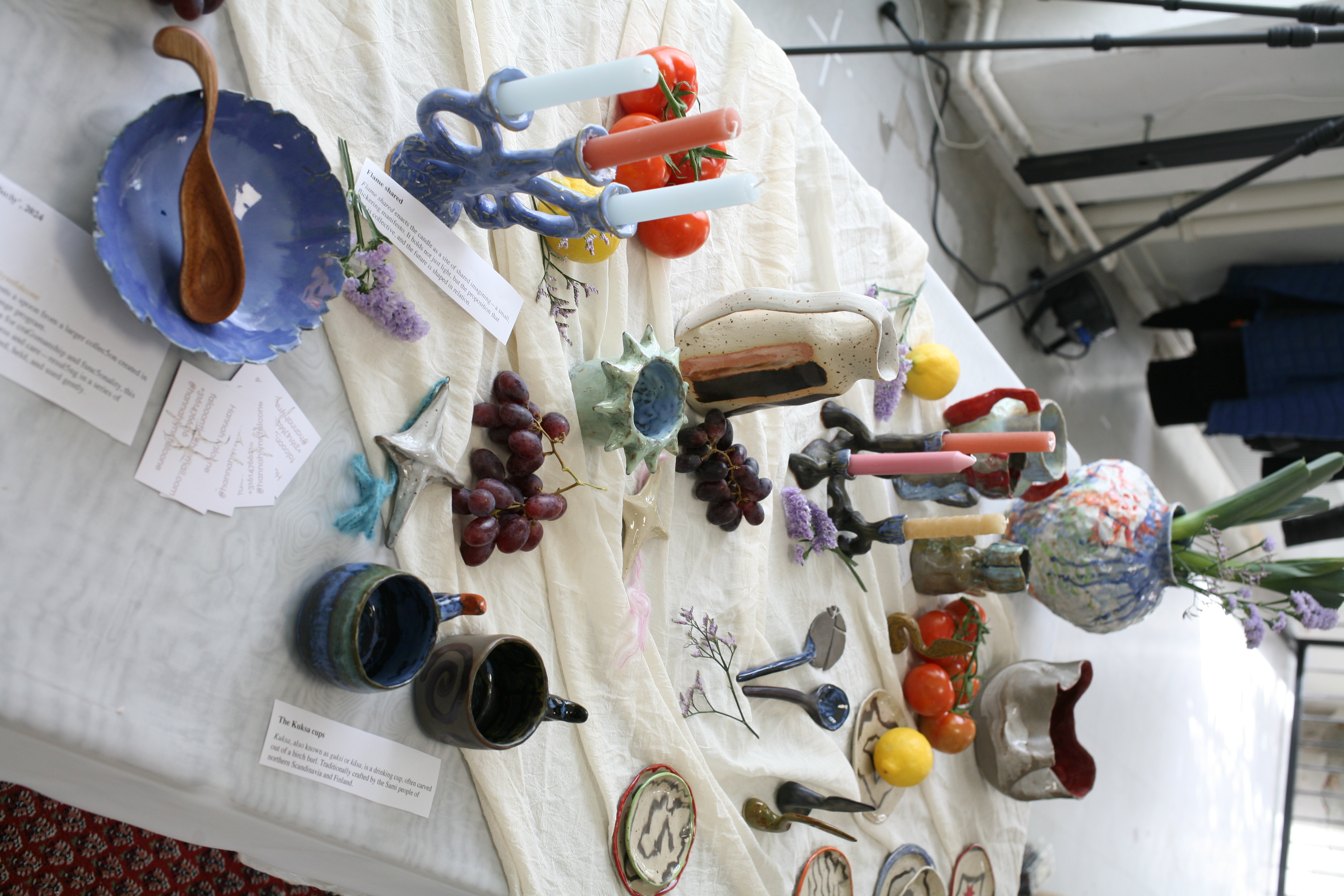
Clay helps me think about this because it carries the same tension: it is soft and strong, collective and personal. It remembers touch but resists mastery. To work with clay is to accept imperfection and to trust in the undertaking. The material teaches humility; it insists that no form, like no community, can ever be entirely finished, nor can you ever have full control over its formation.
My practice often begins with ordinary forms such as a cup, a plate, a vase; the objects that move between hands and bridge the space between people. In Finland, craft traditions have long been tied to survival and hard work. They tell stories of endurance, but also of constraint — particularly for women and for the Indigenous Sámi people, whose creative labour was confined to domestic duty or suppressed in the name of assimilation. To honour these crafts today means to reclaim them.
I imagine a long, uneven table that stretches beyond borders. A table where all workers sit side by side. A table where we eat slowly, where stories are shared and power circulates differently. Here, the act of gathering becomes a rehearsal for another kind of society — one built not on extraction but on relation.
Come closer. Sit down.
There is space for you here.